His Life and Jouney
Ogilvie's Life
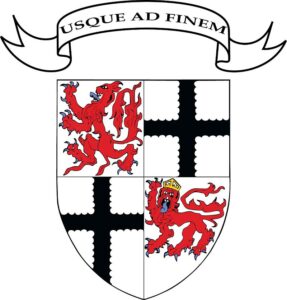
Born into a wealthy land-owning family in Banffshire around 1579, John Ogilvie’s early life was set against the backdrop of a Scotland deep in the throes of the Protestant Reformation. Raised in the Calvinist faith of his father, 12-year-old Ogilvie was sent to continental Europe to receive an upper-class education.
Instead of coming back a quiet nobleman, his travels through France, Germany, and Moravia exposed him to the fierce intellectual debates sweeping Europe. Intrigued by the arguments of both sides, Ogilvie ultimately converted to Catholicism at age 17. He soon joined the Society of Jesus and was ordained a priest in Paris in 1610.
The Undercover Mission
By the early 17th century, practicing or preaching Catholicism in Scotland was illegal and treated as high treason against King James VI. Despite the obvious danger, Ogilvie requested to be sent back to his homeland.
In late 1613, he slipped back into Scotland under the alias "John Watson," pretending to be an ordinary horse trader. For nearly a year, he moved through Edinburgh and Glasgow in disguise, holding secret meetings in private homes, offering spiritual guidance, and rallying the underground Catholic community.
Betrayal and Imprisonment
His covert operation was short-lived. In October 1614, while meeting contacts in Glasgow, Ogilvie was betrayed by a local informant, arrested on the orders of the Protestant Archbishop of Glasgow, and thrown into prison.
Authorities were determined to make an example of him, but they also wanted information: who was harbouring him, and where were the other underground priests? When bribes and physical threats failed to break his resolve, his captors subjected him to the "Vigil"—a brutal method of sleep deprivation. Kept awake for over eight days and nights by being pushed, prodded, and dragged across stone floors, Ogilvie remained defiant and refused to name a single collaborator.
During his imprisonment, Ogilvie managed to secretly draft a detailed account of his interrogations and torture, smuggling the pages out of prison leaf by leaf via sympathetic visitors.
The Trial and Execution
Ogilvie’s trial was ultimately less about his religious rituals and more about political authority. King James demanded a pledge of absolute royal supremacy in all matters, civil and spiritual. Ogilvie offered a sharp compromise: he would readily lay down his life in defence of the King’s civil authority, but he refused to acknowledge any monarch’s power over conscience or faith. When pressed, he famously remarked that he respected royal authority over spiritual matters no more than he respected an "old hat".
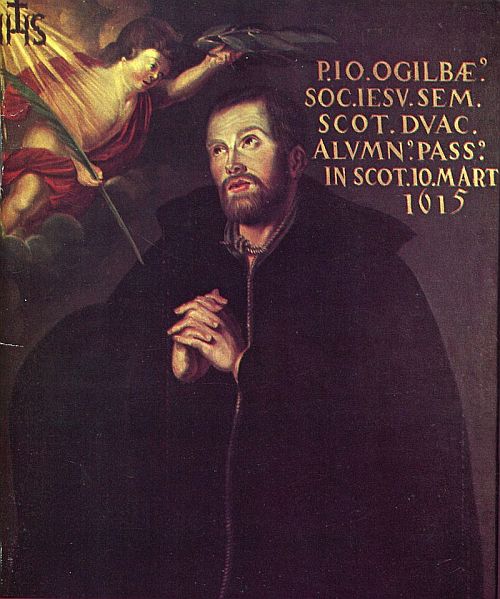
That refusal sealed his fate. On March 10, 1615, at the age of 36, Ogilvie was convicted of high treason and taken to the gallows at Glasgow Cross.
Before a large crowd, he mounted the scaffold. In a final dramatic gesture before being hanged, he threw his hidden rosary out into the onlookers. Local sentiment ran so high that the authorities opted against the traditional public dismemberment typically reserved for traitors, instead burying his body quickly near Glasgow Cathedral.
Legacy
Centuries later, in 1976, John Ogilvie was canonized as a saint and he remains the only Scottish saint recognized from the Reformation era—remembered historically not just as a religious figure, but as an individual of extraordinary psychological grit who refused to yield his personal convictions to state coercion.
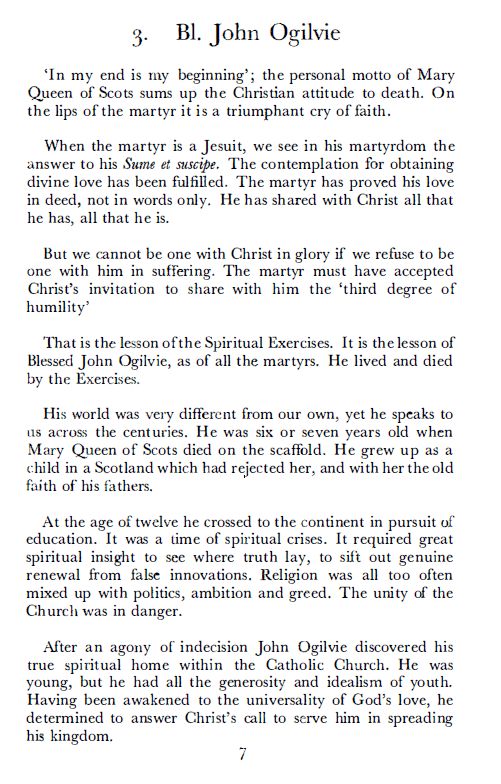
Pamphlet by Fr James Quinn SJ
Click to open...
Timeline of a Saint
|
1579
|
John Ogilvie is born on 4th July at Drum-na-Keith, on the north east coast of Scotland . His father, Sir Walter Ogilvie, conformed to the state religion of Calvinism (established by act of parliament in 1560) and later known as Presbyterianism. His mother, Agnes Elphinstone, was a Catholic with two brothers in the Society of Jesus. |
|
1582
|
John's mother dies when he is three. Walter Ogilvie is remarried, to Mary Douglas. |
|
1592
|
Travels to Helmstedt (an illustrious Lutheran school founded in 1570) to begin his formal education, age 13. |
|
1596
|
Enrols at the Scots College (which had moved from Douai to Louvain), undergoes instruction from Cornelius a Lapide SJ and shortly becomes a Roman Catholic. Then continued his studies at the Jesuit university at Olmütz (Olomouc, founded 1570) in Bohemia because of the poverty of the Scots College. |
|
1598
|
Continues studies with the Benedictines at the Schottenkloster (Irish Monastery) Sankt Jakob, Ratisbon (Regensburg). |
|
1599
|
Returns to Olmütz. Enters the novitiate of the Society of Jesus on 5 th November at Brno in Moravia. |
|
1601
|
Takes his first vows as a Jesuit on 26 th December at Graz in Austria and then teaches grammar in the Jesuit school (founded 1573) while studying philosophy at the Jesuit university (founded 1585/6). |
|
1606
|
Teaches grammar and humanities at Vienna (Jesuit college and university founded 1551). |
|
1607
|
Returns to study at Olmütz to study theology. Appointed Prefect of the Sodality of Our Lady. |
|
1610
|
Ordained priest at Paris and appointed confessor to the students of the Jesuit college at Rouen (founded 1593). |
|
1613
|
Returns to Scotland, landing at Leith, under the alias John Watson, horse dealer. He is accompanied by James Moffat SJ and the Capuchin Franciscan, John Campbell. |
|
1614
|
Ogilvie travels to London and on to France on a secret mission, seemingly under the protection of the King. He returns to Scotland in June. On 14th October, he is betrayed by Adam Boyd and arrested in Glasgow. Imprisoned and tortured for five months in Glasgow and Edinburgh. |
|
+1615
|
John Ogilvie is executed at the Mercat Cross, Glasgow, on 10th March and is buried outside the city walls. |
|
1616
|
Ogilvie's Relatio (his own account of his arrest, imprisonment and torture, written in prison) is printed in various cities in Europe and circulated secretly in England and Scotland. |
|
1629
|
The process to have John Ogilvie declared 'Blessed' is begun but not completed for another 400 years. |
|
1929
|
22nd December - Declared 'Blessed' by Pope Pius XI. |
|
1976
|
17th October - Declared a 'Saint' by Pope Paul VI. |
|
2015
|
400th Anniversary of the martyrdom of St John Ogilvie SJ |
|
2026
|
50th Anniversary of his Canonisation |